

The European border processes are undergoing one of their most significant transformations in decades. With the implementation of the Entry/Exit System (EES), border control authorities, law enforcement agencies, and immigration services face a major shift in how third-country nationals are registered and verified at the external Schengen borders.
Much of the initial industry response has focused on fixed infrastructure: self-service kiosks, traditional border desks, and other permanent verification points. These remain essential tools for border control, but also have their limitations. High-density passenger flows, unexpected surges, regional checkpoints, and mobile field operations require a degree of flexibility that fixed infrastructure alone cannot always provide.
The answer is not to replace the border desk, but to extend it.
Mobile verification can provide an additional operational layer, bringing secure document and biometric capabilities directly to the locations where they are needed. This can help authorities manage peak demand, support exceptional situations, and increase flexibility without having to replicate full fixed infrastructure at every location.
The power of vertical integration:
from silicon to screen
Relying on loosely connected components can introduce unnecessary complexity. A seamless workflow for capturing biometric data, reading a document, or verifying a secure credential depends on the interaction between hardware, drivers, firmware, SDKs, and applications.
Stability and performance are key. This is where vertical integration becomes particularly relevant.
At BPI Services, we engineer and tune the technology stack across these layers, optimizing the interaction between physical hardware, low-level drivers, firmware, native SDKs, and end-user applications. This approach allows us to address performance and stability across the entire process.
Our mobile capture architecture is designed for fast capture, efficient power management, reliable connectivity, and sustained operation in demanding field environments.
Every operational environment is unique. We are experts at operating with different document types, biometric modalities, workflow requirements, and environmental conditions. Rather than relying on generic benchmarks, we invite border professionals and technical leads to exchange experiences with us. Let's look at your specific use case, compare real-world metrics, and benchmark how an integrated mobile approach can elevate your operations.
Cryptographic rigor at the core
Operational flexibility cannot come at the expense of security.
Identity and document verification in high-security environments depend on well-implemented cryptographic protocols and rigorous handling of secure credentials. Mobile solutions therefore need to combine usability and performance with the same security principles expected from fixed border control infrastructure.
Our technology supports all ICAO document-security mechanisms, including PACE, EAC, Passive Authentication (PA), Chip Authentication (CA) and Terminal Authentication (TA). This enables secure interaction with electronic travel documents while supporting the document variations and exception scenarios encountered in real-world deployments.
Cryptographic integrity extends beyond the document itself. The complete workflow also needs secure communication between the reader and the mobile device. Our architecture therefore incorporates secure Bluetooth Low Energy (BLE) connectivity alongside the document and biometric processing layers. The protocol encryption works on the same basis as TLS 1.3, which is the trusted standard for internet traffic encryption used by anyone who browses the internet today.
Full ownership of the entire chain is of the utmost importance due to the sensitive nature of the captured data. As that is the case, our mobile devices are designed to not require any internet connection, do not require a connection to a cloud system and do not store any captured data in any form. This means full offline air-gapped operation.
The objective is straightforward: mobility should extend the operational reach of border control without creating a weaker security environment.
Mobile flexibility in action:
the "Queue-Buster"
For border professionals and law enforcement officers operating in dynamic environments, this integrated approach translates into dedicated mobile tools.
Designed to support police and border professionals independently of time and location, the iMatch series, including the iMatch45 and iMatch50, delivers the agility needed to meet the expanding demands of modern EES workflows. Connected via secure BLE to smartphones, these compact devices combine high-performance fingerprint capture with MRZ and RFID reading capabilities. The iMatch45 and iMatch50 use FBI-certified fingerprint scanners (FAP45/FAP50), enabling officers to perform document and biometric workflows away from a conventional fixed desk.
This creates an additional layer of capacity at the point where it is needed.
At a congested terminal, for example, officers can use mobile equipment to support passenger processing outside the fixed lane environment. In other situations, mobile verification can support checks at regional checkpoints, transit locations, or other operational settings where fixed infrastructure is impractical.
The goal is not to replace fixed border infrastructure. It is to make the overall operation more flexible.
Bridging physical and digital:
Digital Travel Credentials and mDLs
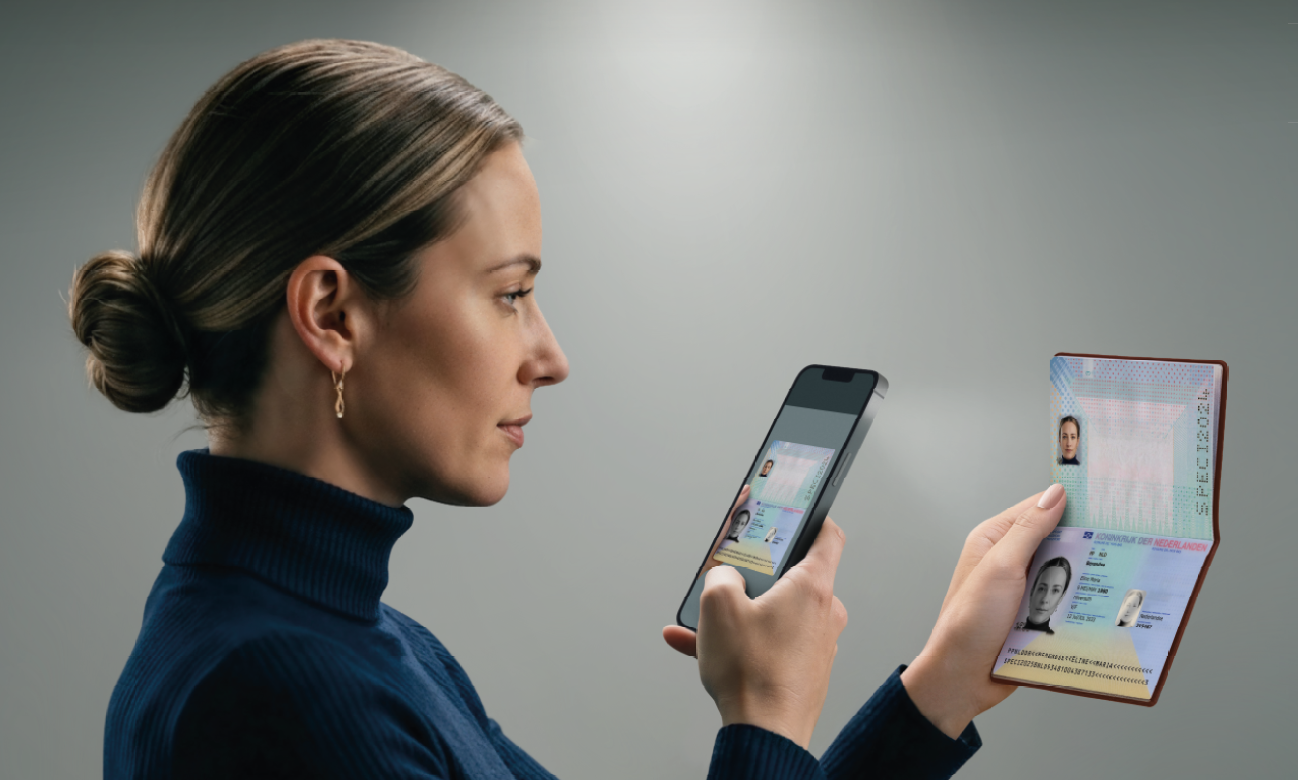
The evolution of border control does not stop with EES. As physical travel documents increasingly interact with digital identity ecosystems, technologies such as Digital Travel Credentials (DTCs) and mobile driving licences (mDLs) are becoming increasingly relevant.
These developments introduce new requirements for mobile readers and verification platforms. Devices need to interact securely with credentials presented through NFC, Bluetooth, apps, servers or other interfaces, while the surrounding hardware and software must be able to support evolving standards and identity frameworks.
Our integrated mobile architecture is designed with this transition in mind. We can create this flexibility due to our full vertical integration, meaning full control over our custom-designed software and hardware stack. Through this we can easily and safely support emerging digital credential workflows alongside established document and biometric processes.
Our technical experts are also participating in European pilot projects involving DTCs and digital identity technologies. This practical involvement provides direct insight into how emerging standards translate into real-world operational requirements.
The objective is not simply to prepare for a digital future, but to build technology that can operate across the transition from physical documents to increasingly digital identity ecosystems.
Driven by practice:
continuous innovation through collaboration
Security technology cannot evolve effectively in isolation. Standards change, document implementations vary, and operational environments continuously expose new edge cases.
Our product development is therefore closely connected to feedback from professionals working in the field. Rather than relying exclusively on fixed development cycles, we use continuous feedback to refine hardware, firmware, software, and SDK functionality.
Over the past year, this has led to frequent software and SDK updates, with improvements driven by operational requirements and integration feedback.
Examples include:
- Continued improvements of the advanced chip validation: expanding our handling of ICAO protocols such as PACE, EAC, PA, and CA to support additional document variations and edge cases.
- Optimized capture and timeout logic: refining fingerprint capture workflows for intensive field use while balancing responsiveness, reliability, and battery efficiency.
- Streamlined integration: continuously improving SDKs and documentation to simplify integration and enable partners and customers to adopt new functionality efficiently.
- Full backwards compatibility and modern software support: all products still receive the same improvements today, despite over a decade of continued hardware revisions.
- Energy efficiency improvements: empowering users to confidently operate the devices on the move.
These improvements are not simply software updates. They represent an ongoing feedback loop between the technology and the environments in which it is deployed. Because this is a modern mobile platform, clients and partners can easily and securely roll out offline Over-The-Air (OTA) updates for the firmware, ensuring field devices stay updated, compliant, and continuously optimized without operational downtime.
The road ahead
EES is not simply a compliance milestone. It is part of a broader transformation in how identity, travel documents, biometrics and border operations interact.
Fixed infrastructure will remain fundamental to border control. But increasingly, authorities also need the ability to move verification capabilities beyond the traditional border desk to where passenger flows, operational requirements, and exceptional situations demand them.
That requires more than a mobile device. It requires an integrated architecture in which hardware, firmware, software, biometrics, document authentication, connectivity, and cryptographic security are designed to work together.
The future of border control will be increasingly mobile, hybrid, and built on verifiable trust.
We are developing the technology to support that transition. If you are exploring mobile EES workflows, biometric verification, digital travel credentials or integration with existing border-control systems, the most useful next step is a conversation with our technical team. No sales pitch, just your use case and our engineers.
Get in touch with Yme Brugts at y.brugts@bpiservices.eu to schedule a technical session.