
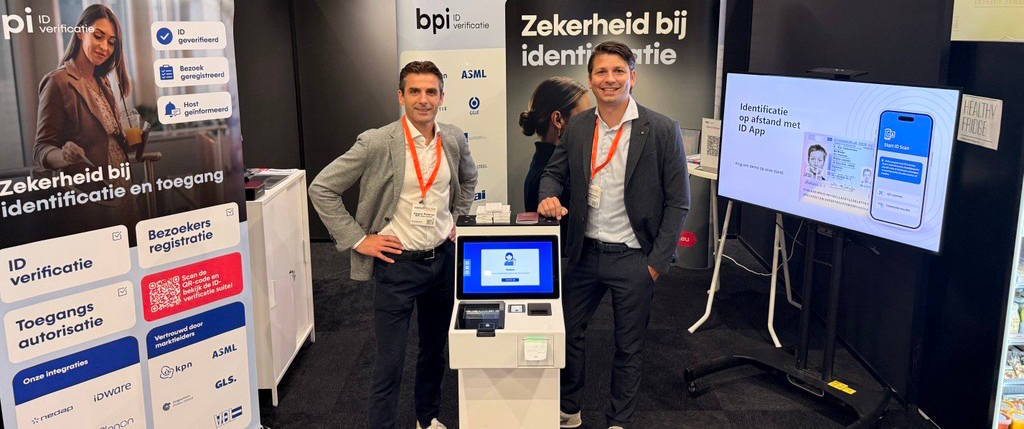

When people think of a self-service kiosk, they often picture a screen where visitors can check in. According to David van Westendorp, Business Development Manager at BPI, that underestimates the potential of modern kiosk solutions.
"More and more organizations are discovering that a kiosk doesn't just help with visitor registration, but can play a key role in overall access management."
David, you speak with many organizations. What challenges do you
encounter most often?
"I actually hear the same challenges everywhere. Organizations want to welcome visitors professionally, but at the same time, processes need to be secure, efficient, and compliant. This applies to healthcare institutions, but just as much to logistics companies, office buildings, production sites, or organizations that receive large numbers of temporary staff daily. You often see reception desks under pressure. During peak times, multiple visitors arrive at once, drivers show up, suppliers come to deliver goods, and employees need to be registered. That’s when you realize how important a well-designed reception process is."
Many organizations already have a reception desk. Why should they consider a kiosk?
"It’s not about replacing the reception. It’s about supporting the people who work there. A receptionist or security guard wants to focus on people, not on repetitive administrative tasks. By automating those standard processes, more room is created for personal contact where it’s needed. Additionally, we are seeing more and more locations that aren't permanently staffed. In those cases, a kiosk offers an accessible way to still welcome visitors professionally."
We get the best feedback when clients discover how many processes they can
automate without sacrificing hospitality. That’s when you see that a kiosk is no longer just a
tool, but a strategic part of the organization."
What can a modern kiosk actually do these days?
"Much more than people often expect. Of course, a visitor can check in, but it doesn't stop there. A visitor can, for example, identify themselves using a QR code, PIN, or identity document. Then, all sorts of processes can be triggered automatically. Think of notifying a contact person, printing a QR or barcode, issuing an access pass, displaying safety instructions, or registering via digital forms. The kiosk thus becomes a central hub within the access process."
You mentioned identity verification. Why is that becoming increasingly important?
"Organizations want to know more accurately who is actually entering their premises. This is important for visitors, but even more so for contractors, temporary workers, and seasonal staff. In many cases, it is necessary to verify that someone is actually the person who should be granted access. With a kiosk, you can make that identification an immediate part of the check-in process. That increases security and eliminates the need for manual checks."
What differences do you see between organizations?
"That depends heavily on the environment in which an organization operates. In environments with a higher risk profile, the focus areas are often different.
For organizations where the risk of aggression at the front desk is higher, a kiosk can contribute to a safer and calmer reception area. Visitors can check in independently, which reduces the pressure on reception staff and allows them to focus on situations where personal contact is truly necessary.
In a different context, such as within judicial organizations, the emphasis is specifically on additional identity verification. There, it is important to establish with a high degree of certainty that the right person is gaining access to the building. The strength of a modern kiosk is that you can tailor the solution to the organization's risk profile and processes."
Do you also see challenges in terms of compliance?
"Absolutely. That is becoming increasingly important. Many organizations still work with paper visitor logs or handwritten forms. That seems simple, but from a privacy and compliance perspective, it carries risks. Data is often incomplete, sometimes kept for too long, and difficult to retrieve when needed. By recording registrations digitally, you gain much more control. In addition, you can much better implement important privacy principles, such as data minimization and the automatic application of retention periods. This ensures that only necessary data is processed and personal data is not kept longer than required. This helps organizations work in a compliant manner without additional administrative burdens."
How does BPI distinguish itself with the ID Kiosk?
"What we hear a lot from customers is that they value flexibility. We develop both the hardware and the software ourselves. This allows us to adapt solutions to the customer's wishes instead of the other way around. One organization may need a simple registration kiosk with route information. Another organization may want a badge printer, identity verification, or integrations with existing systems. Because our solution is modular, we can fully tailor it to the customer's situation."
What do you see as the future of visitor and access management?
"I think organizations are increasingly looking for a combination of ease of use and security. People nowadays expect a fast and simple reception experience. At the same time, organizations want to maintain control over who is present, what rights someone has, and how data is processed. A kiosk plays an increasingly important role in this. Not as a standalone device, but as part of a broader solution for visitor management, identity verification, and access control. Ultimately, it comes down to one question: how do you welcome people in a professional manner without creating extra work for the organization? That is exactly where the strength of a modern self-service kiosk lies."